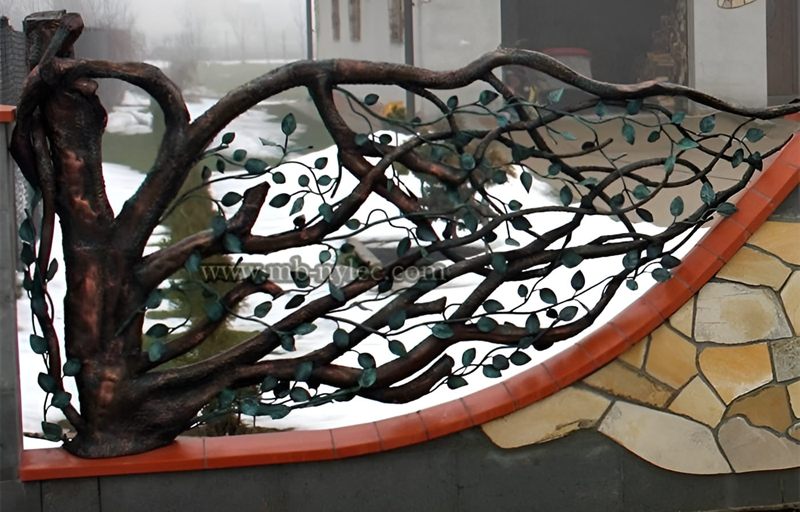
This metal tree fence takes one idea and follows it all the way through. At the post end stands a short, heavy trunk, its bark hammered into ridges and knots, with a broken-off stub at the top. From it the limbs swing out almost horizontally over the wall, splitting again and again until they end in thin twigs carrying small green leaves. The lower part of the tree is calm and solid; the upper part is open, so the garden stays visible through the branches.
The branches are not laid out in one flat plane. They cross over and under each other at different depths, which is why the fence casts layered shadows and looks just as convincing from an angle as head-on. On the house shown, the branches follow the sweep of a curved wall capped in red tile, so the tree seems to lean with the line of the masonry. The bark carries a copper-brown colouring and the leaves are green.
Built heavy, built to order
Despite the delicate twigs, this is serious structure: a running metre of this kind of fence can weigh several hundred kilograms, all of it shaped from steel by hand. Each project is drawn for its site, so the trunk can stand at a post, in the middle of a run or at a corner, and the pattern can be changed in any way you like. The same tree can continue into a wicket and a driveway gate for one consistent entrance; our tree-shaped garden gate is one example. Fences of this type can be seen in our gallery in Dębica, Poland, and more ideas are in the sculptural fence collection.
 Sculpture Studio